Indian police last week arrested Hassan Ali Khan, who was wanted for investigations into money laundering and other illicit activities, and who is also said to have ties to Dawood Ibrahim, the underworld kingpin who evidence indicates was the mastermind behind the terrorist attacks in Mumbai last month.
Ibrahim is also alleged to have close ties with both Pakistan’s Inter-Service Intelligence (ISI) agency and the CIA.
Another character linked to the CIA whose name is now beginning to figure into the web of connections between the Mumbai attacks, criminal organizations, and intelligence agencies is Saudi arms dealer Adnan Khashoggi, of Iran-Contra infamy. Khashoggi has been implicated in arms deals with drug traffickers and terrorist groups, including within India.
Dawood Ibrahim is a known major drug trafficker whom India claims is being protected by Pakistan. As Foreign Policy Journal previously reported, there are also some indications that the CIA has a similar interest in preventing Ibrahim from being handed over to India. Ibrahim is wanted by India for the recent Mumbai attacks as well as for bombings that occurred there in 1993.
Ibrahim is a native of India who rose through the ranks of the criminal underworld in Bombay (now Mumbai). According to media reports in India, he got his start as an undercover informant for the police at a young age and thus has an intimate knowledge of Indian law enforcement and intelligence, and is alleged to have fostered close ties with individuals within the political system.
Another known associate of Ibrahim’s in Mumbai, Mohammed Ali, is suspected of assisting the terrorists, who were met by an individual in Uran before continuing on to Mumbai, where inflatable rubber dinghies had been arranged to take them ashore by the same individual. Numerous earlier press accounts indicated that the dinghies, along with other logistical assistance, were provided by an associate of Ibrahim’s.
The Times of India, for instance, reported on November 28 that according to police sources the Mumbai attack “was enabled by the Dawood Ibrahim gang“, and that “It would not have been possible to carry out a terror operation on this scale without a collaborative local network and this was provided by the D Gang. As the terrorists had entered via the sea, the needle of suspicion is clearly pointing at Mohammed Ali, the new poinstman of Dawood.”
Yet Indian news reports indicate that officials have been slow to act against Hassan Ali Khan, and Mohammed Ali continues smuggling operations out of Mumbai for Ibrahim’s crime syndicate, D-Company, completely unmolested by Indian investigators and law enforcement.
As the November 28 Times of India article observed, Ali “is known to indulge in smuggling of diesel, petroleum, naptha, drugs and arms with impunity and it appears that the terrorists had used his networks to enter the city by the sea route…. Despite having a detailed dossier on him, the authorities have not taken any action against him. What is more worrying is that Ali is believed to have also penetrated naval intelligence.”
A further report from the Times of India on December 4 noted that Dawood Ibrahim is “sitting pretty in Karachi” under the protection of Pakistan and his “hawala channel between Mumbai and Karachi remains busy”. “But central agencies question why the Maharashtra government has not taken any action against the D-company here.”
“‘What’s the point of asking Islamabad to hand over Dawood when we’re not doing anything to destroy his empire in Mumbai and other places in India?’ a senior official asked.”
The article observed that Mohammed Ali “continues to operate with impunity.
Again, on December 11, Times of India reported that “Mumbai police has still not called Ali for questioning”, adding that “Ali is also known to have the backing of two powerful politicians of south Mumbai and that could be the reason why he is still untouched.”
In addition to links to Ibrahim, both men are also alleged, like Ibrahim himself, to have ties to political officials in India, and there are numerous other indications emerging that the attacks were assisted by elements within India being protected by the political establishment.
Hassan Ali Khan
India’s Daily News & Analysis reported last week that it appears Hassan Ali Khan “was part of a multi-crore [Indian numerical unit equivalent to ten-millions] hawala syndicate racket and may have joined hands with the organized crime operated by underworld don Dawood Ibrahim. He is also suspected to have funded terror organizations.”
India’s Enforcement Directorate (ED) “had also told the Bombay High Court that there were indications that Ali was part of a strong international crime syndicate with money flowing in from ‘proceeds of heinous crimes like terrorism, arms trade, gun running, corruption and organized forgery’.”
A series of news reports from March 2007 in the Times of India revealed that Khan was being investigated for money laundering and other illicit activities. A laptop recovered from his home showed that he had accounts at a Swiss bank. Khan had reportedly tried to take advantage of tax waivers granted on investments originating outside India in countries with double taxation avoidance agreements with India. The funds were also be used to invest in the stock market.
Khan would send funds abroad through illegal channels and re-route them into India through shell companies in countries with such a tax arrangement with India. According to the Times of India, “Khan has no known sources of income in India but owns stud farms and often travels abroad.” His wealth is estimated to be in the billions, and he owns property in Mumbai and Pune.
Investigators from the Enforcement Directorate (ED) “had crucial input from the Intelligence Bureau, which was concerned about this unaccounted money having implications for national security.”
One of the countries used to route money back into India was Mauritius, an island chain off the east coast of Africa near Madagascar and a former British colony. The UK still maintains a military presence there. It expelled the inhabitants of the island of Diego Garcia in order to turn it into a military base, which has also been used by the US for its own military operations.
According to reports, prior to the terrorist attacks in Mumbai, a team had been sent ahead and checked into the Taj Mahal hotel, one of the key targets of the attacks, and established a control room where they had food, weapons, and other supplies waiting in anticipation of the siege of the hotel by police and special forces. An identification card from Mauritius was used to check into the room.
Hassan Ali Khan has an interest in horse-racing and trades in thoroughbreds. The Times of India reported that “he had attracted attention on the Pune racing turf where he surfaced about five years ago as a small-time punter who suddenly became one of the biggest players. His contacts, by default, were with some of the top industrialists who have an interest in horse-trading.”
Last February, the Hindustan Times reported that the Swiss bank involved in the money transfers, USB (United Bank of Switzerland) AG, was reluctant to assist Indian investigators, and the investigation had been stalled as a result. The ED had advised the Indian government not to approve a plan by UBS AG to buy Standard Chartered Bank, an Indian mutual fund business, because of its lack of cooperation in tracking Khan’s money transfers. According to the ED, Khan had $8 billion in the bank’s accounts.
Adnan Khashoggi
The Hindustan Times also revealed that there was evidence that Saudi arms dealer Adnan Khashoggi of Iran-Contra infamy had transferred $300 million to Khan from a Chase Manhattan bank account in New York. It added that Khashoggi’s “arms supplies to Tamil terrorists, the LTTE, were revealed during an investigation into the 1991 assassination of Rajiv Gandhi.”
Khashoggi acted as a middle-man during the Iran-Contra affair, brokering an arrangement for Israel to sell US arms from its own stockpiles to Iran. The CIA then channeled money from the sales to the Contras in support of their terrorist war against the democratically-elected government of Nicaragua. The World Court later condemned the United States for the “unlawful use of force” – a euphemism for international terrorism or the even greater crime of a war of aggression.
Investigative journalist Wayne Madsen recently reported that, according to Asian intelligence sources, Khashoggi was also involved with the CIA in an effort to support Bosnian Muslims that “brought [Dawood] Ibrahim and [Osama] Bin Laden into the same big CIA tent, along with Saudi arms dealer Adnan Khashoggi, a key Iran-contra figure in George H. W. Bush’s global arms smuggling venture while he served as Vice President under Ronald Reagan. There have been reports that Ibrahim considers Khashoggi to be a hero figure.”
In 1991, a Defense Intelligence Agency report listed Khashoggi as “An international arms trafficker who allegedly has sold arms to the Colombian drug traffickers, especially to the Medellin Cartel.”
The DIA report also listed Washington’s man in Columbia, Alvaro Uribe Velez, as “A Colombian politician and senator dedicated to collaboration with the Medillin Cartel at high government levels. Uribe was linked to a business involved in narcotics activities in the US…. Uribe has worked for the Medillin Cartel and is a close personal friend of Pablo Escobar Gaviria.”
Uribe is now the President of Colombia, which receives enormous amounts of US financing and military support, surpassed perhaps only by US support for Israel, Egypt, and now Iraq.
Manuel Noriega was another infamous narcotics trafficker and CIA asset, as well as a graduate of the School of Americas (SOA), which has since changed its name to the Western Hemisphere Institute for Security Cooperation (WHINSEC). The SOA was responsible for training numerous Latin American dictators and military commanders who were responsible for torturing, murdering, or otherwise “disappearing” countless political opponents and other individuals.
Colombia is also another case where the government has been caught red-handed staging false-flag terrorist attacks. In the late 1970s, a series of bombings, kidnappings, and assassinations against leftist targets was carried out by a terrorist group known as the American Anti-Communist Alliance (AAA or Triple-A). Documents available online at the George Washington University National Security Archives confirm that Triple-A “was secretly created and staffed by members of Colombian military intelligence in a plan authorized by then-army commander Gen. Jorge Robledo Pulido.”
John Perkins, author of Confessions of an Economic Hitman, wrote in his follow-up book The Secret History of the American Empire that a second lieutenant in the US army sent to Colombia to establish a “United States-commanded Southern Unified Army” told him, “Everything we do in Colombia just makes it more attractive for the drug business. Why do you think the situation keeps getting worse there? Because we want it to, we’re behind the drug trafficking. The CIA is–just like it was in Asia’s Golden Triangle.”
One might add the “Golden Crescent” to that list. As Foreign Policy Journal previously reported, Dawood Ibrahim “is known to be a major drug trafficker responsible for shipping narcotics into the United Kingdom and Western Europe.” While most Afghan opium is smuggled to Europe over land through Iran and Turkey, much of the amount that goes to Pakistan seems to be taken either by plane or by ship directly to the Europe, principally the UK.
While Pakistan claims Ibrahim is not even in the country, India insists he has been living in Karachi under the protection of Pakistan’s Inter-Services Intelligence (ISI) agency.
The ISI worked closely with the CIA during the Soviet-Afghan war and acted as the CIA’s intermediary to provide funding, weapons, and training to the Afghan mujahedeen. The opium trade was used to finance the CIA-backed mujahedeen, and the principle beneficiary of CIA support was Gulbaddin Hekmatyar, who was also a principle drug lord.
And while Western media accounts typically tend to characterize today’s opium trade as being under the control of the Taliban, the fact is that the estimated amount of funds going to the Taliban and all other anti-government elements combined is less than 14 percent of the total estimated export value, and US intelligence agencies are aware of the involvement of high-level officials within the Afghanistan government in the drug trade, such as Rashid Abdul Dostum, former Chief of Staff to the Commander-in-Chief of the Afghan Armed Forces. Dostum was also among the warlords of the Northern Alliance the CIA doled out suitcases of cash to during the initial phase of the US war to overthrow the Taliban.
Viktor Ivanov, the director of Russia’s federal anti-narcotics service, said in an interview recently that “The gathered inputs testify that infamous regional drug baron Dawood Ibrahim had provided his logistics network for preparing and carrying out the Mumbai terror attacks by the militants.” He added that “The super profits of the narco-mafia through Afghan heroin trafficking have become a powerful source of financing organized crime and terrorist networks, destabilizing the political systems, including in Central Asia and Caucasus.”
A Protected Man in India
The $300 million transfer to Hassan Ali Khan from Adnan Khashoggi was “only the tip of the iceberg”, an official from ED told the Hindustan Times. There was also evidence of another $290 million, for instance, in two shell companies in the British Virgin Islands. This was among the evidence obtained from the laptop computer seized from Khan’s home in Pune.
In addition to the money transfers, the ED was investigating Khan’s possession of three Indian passports. He held passports issued from Pune, Patna, and Mumbai, and had also applied for additional passports from Guwahati and Chandigarh. He and his wife had applied for citizenship in Switzerland.
But it wasn’t only the Swiss bank’s apparent unwillingness to cooperate with Indian investigators that was slowing progress in the inquiry into Khan’s dealings. The Times of India reported in February that although the Prevention of Money Laundering Act provided for his arrest, the ED had yet to do so. The ED was “acting cautiously in this case, sources said.” The paper added that “It is shocking that Khan could have concealed all that money without Indian agencies getting to know of it.”
The report says that “The lack of evidence on the transactions seems to have prevented ED from arresting Khan”, while at the same time noting that “The alleged presence of names of Indian politicians also found from Khan’s initial questioning by the income tax and ED officials immediately after the raid last year, don’t figure anywhere in the submissions made by the ED to the HC [High Court]. The Income tax department has failed to get information from the ED on the sources of the $8 bn, despite asking for it again and again.”
In September, the Times of India reported that the intelligence community was “seething with anger for being blamed by politicians for its ‘failure’ to prevent” a series of bombings across the country. A senior intelligence official responded to the charges by telling the Times of India that it was the politicians who were at fault, and connected Khan to investigations of terrorism.
“Take the case of Hassan Ali, the Pune-based businessman,” he said. “He was under the scanner of several Central agencies, including the Intelligence Bureau, Enforcement Directorate, Directorate of Revenue Intelligence and other bodies. Finally it was found that he had handled hawala transactions valued at a mind-numbing Rs 35,000 crore through Swiss banks.”
Hawala is an informal money transfer system that is an alternative to formal banking institutions. Often, relatively little money actually exchanges hands between hawala brokers, who operate on an honor system. An amount deposited with one broker is not actually moved to another broker on the receiving end. Rather, that amount is simply taken from the receiving broker’s own reserves. The only funds that actually need be transferred are those used to offset imbalances between brokers, and there is no record of the transaction between the sender of the funds and the beneficiary.
The hawala system is thus ideal for moving illicit funds and for money laundering. According to a World Bank report, “The bulk of drug-related financial flows within Afghanistan, and also to and from neighboring countries (primarily Pakistan), occur through the ubiquitous hawala (informal financial transfer) system.”
The report also notes that “Dubai appears to be a central clearing point for international hawala activities, and various cities in Pakistan also are major transaction centers.” Dubai is a central location for the financial operations of Dawood Ibrahim’s D-Company.
The September article from the Times of India continued, “The bank accounts were traced and he [Khan] was brought in for interrogation. How was it possible for a businessman to have access to so much cash, was the question on everyone’s mind. The probe was stymied midway by vested interests with political clout. Ali has done the vanishing act. His wife and brother-in-law too are missing. ‘Why was he allowed to go scot free?’ asked an IPS [Indian Police Service] officer.
“Sources said there was no evidence of any concrete link between Ali and terror funds. ‘Nevertheless, why was he taken off the hook? In any other country, he would have been put through the grind given the volume of his transactions. But in India he has been treated with kid gloves because of the political backing that he enjoys,’ another official said.
“In another case, the Mumbai crime branch had gathered evidence about the alleged links between a famous Pune businessman and Pakistan-based brother of don Dawood Ibrahim, Anees Ibrahim.
“An eyewitness gave a detailed account of the goings-on between the businessman and Hamid Antulay, Dawood’s nephew in Dubai, and later between the trader and Anees in Karachi. However, the businessman has not been arrested despite the disclosures made more than a year ago. ‘We are expected to fight crime, but politicians do not give us a free hand,’ a crime branch officer complained.”
Mohammed Ali
The Times of India also noted that “Dawood Ibrahim’s key contact person is Mohammed Ali, who is known to control smuggling operations in city docks. ‘Any consignment can be taken out or brought into the country by Ali’s huge gang. A detailed dossier on his activities, which has serious security implications for the country, has been sent to the Union home department. But there has been no response so far,’ an official said.”
Mohammed Ali also seems to be a protected person in India. Just days after the Mumbai terrorist attacks, the Times of India stated that Mumbai residents “now know their government has done nothing at all to protect the country’s financial capital”, and again noted that “The Intelligence Bureau (IB) has sent a detailed dossier about the activities of one Mohammed Ali, who is the uncrowned king of the docks. A close aide of Karachi-based terrorist Dawood Ibrahim, Ali smuggles petrol, diesel, drugs, arms and other contraband with impunity.”
“There are strong indications,” the Times of India added, “that the D-gang actively collaborated with the terrorists in these attacks. And yet, the government is reluctant to move against Ali and his gang because he enjoys the patronage of a powerful politician, known to be a business partner of Dawood.”
The article adds, however, that “Any terror operations needs vast funds, via the hawala route. But the authorities are still to crack down on hawala operators. Recently, they picked up Hasan Ali, a racehorse owner in Pune.
“A joint probe by the IB [Intelligence Bureau], enforcement directorate [ED] and directorate of revenue intelligence revealed that Hasan Ali had handled hawala transactions worth a whopping Rs 35,000 crore, much of it belonging to two Maharashtra politicians.”
A police officer told the Times of India at the time, before his recent arrest and while he was still missing, “I will not be surprised if Hasan Ali has been done away with. He is the man who knows too much.”
Hemant Karkare and False Flag Terror
Maharashtra Anti Terrorism Squad (ATS) chief Hemant Karkare, who also formerly an officer in India’s Research Analysis Wing (RAW) intelligence agency, had been in the spotlight for leading the investigation into a series of bombings in the town of Malegaon that was originally blamed on Pakistani-based Muslim terrorists. But Karkare’s probe revealed that the perpetrators were in fact Hindu extremists. Included in the arrests was a serving army officer, Lt. Col. Prasad Shrikant Purohit.
The revelations of false-flag terrorism being carried out by home-grown elements sent shock waves through the political establishment.
As the Independent reported on November 23, just days before the attacks on Mumbai, “Bomb attacks are not uncommon in India – there has been a flurry in recent months – but police usually blame them on Muslim extremists, often said to have links to militant groups based in either Pakistan or Bangladesh. As a result, the recent cracking of the alleged Hindu cell has forced India to face some difficult issues. A country that prides itself on purported religious and cultural toleration – an ambition that in reality often falls short – has been made to ask itself how this cell could operate for so long. India’s military, which prides itself on its professionalism, has been forced to order an embarrassing inquiry.
“The near-daily drip of revelations from police has also caused red faces for India’s main political opposition, the Hindu nationalist Bharatiya Janata Party (BJP), ahead of state polls and a general election scheduled for early next year. The BJP and its prime ministerial candidate, Lal Krishna Advani, have long accused the Congress Party-led government of being soft on terrorism that involved Muslims. However, the BJP has refused to call for a clampdown on Hindu groups, and last week Mr Advani even criticized the police over the way they questioned one of the alleged cell members…”
Karkare was put under immense political pressure and was heavily criticized by Hindutva (Hindu nationalist) leaders and members of the BJP. He had received a number of death threats as a result of his investigation, including a threatening call just one day prior to the attacks in Mumbai last month.
Karkare was killed during those attacks. Rumors with far-reaching implications began to spread immediately that he had been deliberately targeted.
Images of Karkare putting on an ill-fitted bullet proof vest just before his death were widely shown on Indian television. Indian Express noted, “His last visuals as seen on TV showed him working with his men near the VT station [Victoria Terminus, the former name of the Chatrapati Shivaji central train station], the target of one of the attacks, although it is perplexing at this point in time why such a senior officer ended up getting exposed to a brazen terrorist attack. Initially, he was shown wearing a shoddy helmet normally seen used by constables during riots. A little later, a policeman lowers a flimsy bulletproof vest over his shoulders, one that was obviously of little protection when those fatal shots were fired at him.”
According to the Pakistan Daily Mail, Karkare and several of his colleagues “had received information that their colleague Sadanand Dutt had been injured in the gunfire at the Cama and Albless Hospital for women and children.” As they were driving their truck to the scene, according to the only police officer to survive that attack, Arun Jadhav, “two terrorists stepped out from behind a tree and opened fire with automatic rifles”.
The Daily Mail article implicated Hindutva elements and Indian intelligence in terrorist attacks, stating that Bal Thakeray, the leader of Shiv Sena, a Hindu nationalist party, has “publicly pronounced in the past to setup Hindu suicide squads to target Muslims in India and Pakistan”, and claiming that “The terrorist activities and training needs of these groups are closely coordinated by the Indian intelligence agencies, particularly RAW”, which “trained the Tamil separatists groups of Sri Lanka such as the Liberation Tigers of Tamil Elam (LTTE) to start [a] militant secessionist movement based on terrorism in the Sri Lanka’s Jaffna peninsula.”
A government investigation into the assassination of Prime Minister Rajiv Gandhi, the Jain Commission, in fact confirmed that “The LTTE was getting its supplies, including arms, ammunition, explosives, fuel and other essential items for its war in northern Sri Lanka against the Indian Peace Keeping Force from Tamil Nadu. That too with the support of the Tamil Nadu government and the connivance of the law enforcement authorities.”
As noted previously, the investigation found that Adnan Khoshoggi had dealt arms to the LTTE. The commission’s report also noted that LTTE’s involvement in arms smuggling and other illicit activities “were tolerated” and that a number of murders demonstrated the “impunity with which the LTTE could operate in India.”
Earlier this week, Amin Solkar, a lawyer in Mumbai, pressed the High Court to launch an independent investigation into the circumstances under which Karkare was killed. According to India Today, “The Muslims in Malegaon have always claimed Karkare was killed by Hindutva militants and not by Qasab.”
“Qasab” is an alternate spelling for “Kasab”, a reference to Azam Amir Kasab, the only terrorist from last month’s attacks to be captured alive. A transcript of his confession to interrogators was leaked to the media and contains the following statements: “When we were coming out of the hospital premises, we suddenly saw one police vehicle passing in front of us. Therefore, we took shelter behind a bush.
“Another vehicle passed in front of us and stopped at some distance. One police officer got down from the said vehicle and started firing at us. One bullet hit my hand and my AK-47 dropped down. I bent to pick it up when second bullet hit me on the same hand. I got injured. Ismail opened fire at the officers who were in said vehicle. They got injured and firing from their side stopped.” Kasab and his companion, Ismail, then removed the bodies of three dead officers and apprehended the vehicle.
Assuming this incident is the one in which Karakare and his colleagues were killed, this characterization of events seems to cast doubt on the theory that the officials were deliberately targeted for assassination, set up and ambushed. But the Joint Commissioner of Police Rakesh Maria, who is in charge of the investigation into the attacks, Rakesh Maria, has rejected the authenticity of the confession document.
Pakistan’s The News reported earlier this week that “A Pakistani lawyer C M Farooque claimed that many people, including Ajmal Kasab, were arrested before 2006 from Kathmandu by the Indian agencies with the help of Nepalese forces.” Farooque said he was contacted by Kasab’s parents and had filed a petition with the Nepalese Supreme Court with regard to the disappeared individuals last February. “The people arrested in Nepal,” the report added, “had gone there on legal visa for business but Indian agencies were in the habit of capturing Pakistanis from Nepal and afterwards implicated them in the Mumbai-like incidents to malign Pakistan.”
Kasab is from the Punjab province of Pakistan. Rakesh Maria said last week that “He expressed his desire to write a letter to his parents. He wants to write the letter saying he was misled by the group.”
More questions about the death of Hemant Karkare were raised this week by Union Minority Affairs Minister A. R. Antulay, who also implied that he may have been deliberately targeted with the involvement of others. “Superficially speaking they [the terrorists] had no reason to kill Karkare. Whether he was a victim of terrorism or terrorism plus something I do not know,” he told reporters.
“Karkare found that there are non-Muslims involved in the acts [of] terrorism during his investigations in some cases. Any person going to the roots of terror has always been the target.” He added that “There is more than what meets the eye” with regard to Karkare’s killing.
After coming under fire for his remarks, he responded by asking, “How come instead of going to Hotel Taj or Oberai or even the Nariman House, he went to such a place where there was nothing compared to what happened in the three places?” He asked, “Why all the three (Hemant Karakre, Vijay Salaskar and Ashok Kamte) went together. It is beyond my comprehension.”
He later defended his remarks further, asking, “Who had sent them to Cama Hospital? What were they told that made them leave for the same spot in the same vehicle?” He added, “I repeat what I had said. I had not said who had killed them but only questioned who had sent them there in that direction.”
Rajiv Pratap Rudy, spokesman for the BJP party called the remarks “obnoxious” and called for a “clarification from the Prime Minister” whether this was a private view or one held by his government. Congress spokesman Abhishek Singhvi said, “we do not accept the innuendo and the aspersions cast” by Antulay’s remarks. “This should be the end of the matter. The Congress does not agree with Antulay’s statement.”
Others were more inclined to take the remarks seriously. Union Minister Vilas Paswan noted that Antulay was from Maharashtra and suggested he must therefore have “more information”.
Vijay Salaskar, who, as previously noted, was killed along with Karkare, “had closely investigated the entrenched links between a prominent gutka [a betel-nut and tobacco based product] manufacturer and the Dawood gang,” The Times of India reported in an editorial piece. “He had unearthed a mass of evidence about the manufacturer’s visit to Dubai, where he met Hamid Antulay, a nephew of Dawood, and then went on a false Pakistani passport to Karachi where he met the don and his brother Anees. The purpose of the visit was to settle a business dispute with a rival.
“Salaskar found out that the manufacturer was Dawood’s partner in the gutka business, alongside a leading politician who dabbles in real estate development. Despite Salaskar’s best efforts, he was never allowed even to summon the manufacturer for questioning.”
The editorial continued, “The details of Dawood’s vast business transactions and the man fronting it are available with the Central government. But there is inaction. Is it any wonder the security agencies are deeply cynical about enforcing law and order and protecting the country? Is it any wonder the people are enraged?”
On December 6, Maharashtra’s former revenue minister Narayan Rane alleged in a press conference that the terrorists who had attacked Mumbai the week before received “logistical and financial” support from a number of politicians. According to the Press Trust of India, Rane also alleged that former chief minister Vilasrao Deshmukh had links with a person connected with fugitive gangster Dawood Ibrahim.”
Indians Arrested in Connection with Attacks
Two Indians were also arrested in connection with the recent Mumbai attacks. One of the men, Tauseef Rahman, reportedly bought SIM cards that were used by the terrorists, which were purchased in Calcutta according to a report from the Associated Press. The other, Mukhtar Ahmed, was an undercover operative of for a special counter-insurgency unit of the Calcutta police force.
Another Indian citizen, Faheem Ansari, was arrested in February and is now being questioned about his possible involvement. According to the AP, he was found “carrying hand-drawn sketches of hotels, the train terminal and other sites that were later attacked”. According to lead investigator Rakesh Maria, “Ansari was trained by Lashkar and sent to do reconnaissance.”
India’s top law enforcement official, Home Minister Palaniappan Chidambaram, apologized for failing to stop the attacks, saying “There have been lapses. I would be less than truthful if I said there had been no lapses.”
In fact, as previously reported by Foreign Policy Journal, Indian intelligence had numerous warnings of an imminent attack, both from its own sources and from the US. The warnings were specific, including that it would come from the sea. Mumbai, and even the Taj Mahal hotel, were identified as specific targets.
Additionally, Rakesh Maria said his investigation was looking into the possible involvement of Riyaz Bhatkal, the leader of the Indian Mujahideen (IM), in the attacks. “We are looking at various possibilities about who could have provided vital local support and intelligence. Bhatkal being a local person is known to have links with terror outfits.”
In October, Indian Express reported that Bhatkal and a terrorist named “Shahrukh” might be the same individual. “Sources said that since his name was linked to the 1993 Mumbai blasts, Bhatkal may have used the name Shahrukh to protect his identity,” the newspaper said. One official said, “For the 1993 blasts, he arranged money from Pakistan through hawala channels. But he could not be arrested.” In addition, “Officials also suspect an underworld link to the blasts. ‘Since Bhatkal’s name came up in the Mumbai blasts, it is evident that he is an important financial link for the underworld,’ said a source.”
Whitewash of the Attacks
Foreign Policy Journal previously reported on indications that the role of Dawood Ibrahim and his network of organized crime in the attacks in Mumbai last month is being downplayed by both Pakistan and the US and assessed that this was “possibly the result of a deal taking place behind the scenes between the governments of the US, Pakistan, and India, to have others involved in the Mumbai attacks turned over while quietly diverting attention from a man who some say could reveal embarrassing secrets about the CIA’s involvement in criminal enterprises.”
What’s clear now, as further developments have come to light, is that there are also elements within India, both in the criminal underworld and the government, that are perfectly willing to see the role in the Mumbai attacks of an even larger shadowy international criminal network whitewashed; a network with links to numerous moneyed interests, including trafficking in drugs and arms, and to numerous intelligence agencies, including the ISI, the CIA, and India’s own RAW.
While Dawood Ibrahim is officially a wanted man in the US and India, and is on Interpol’s wanted list, the evidence emerging from last month’s terrorist attacks in Mumbai is yet another indication that what is commonly referred to as a “shadow government” or “deep state” extending well beyond national boundaries is really pulling the strings behind the scenes in countries around the world, while the public–such as the residents of Mumbai–and well-intentioned individuals within their democratically-elected governments are left paying the price, often in blood.

The American CIA almost killed Musharraf. The ISI is familiar with terrorism inside Pakistan by the spy agencies of many countries. Even Libya’s Gaddafi once ordered a couple of bombings here after the execution of his friend Mr. Bhutto. But this is the first time that the CIA is found directly involved in working against Pakistani interests. The U.S. spy organization is sponsoring the multibillion dollar Afghan drug trade, helped by the Indians. CIA’s latest trash is a statement by a U.S. congresswoman and a book by a third-rate American journalist both aimed at discrediting the ISI in the eyes of its own people. The million dollar question is this: Why is CIA sponsoring the campaign to tarnish Pakistani image worldwide, from the nuclear scare to the breakup scare to the ‘terrorist’ scare? The answer is astonishing.
By Sandra Johnson in Washington DC
Christina Palmer in New Delhi
Jamal Afghani in Kabul
Makhdoom Babar in Islamabad
17 February 2009.
WWW.AHMEDQURAISHI.COM
Coffee and aspirin, aspirin and coffee. This is what the Chief of the ISI Lt. General Ehsan-ul-Haque was repeating after he went through the news on the website of a U.S. newspaper in which a news report filed by a U.S. news agency claimed quoting “U.S. intelligence sources” that Pakistani President Pervez Musharraf survived the bomb attack on his motorcade because the President’s limousine was equipped with state-of-the-art jamming devices.
The news appeared on Dec. 18, 2003, shortly after former President Musharraf’s motorcade was attacked through a remote controlled device connected to a cell phone on a bridge in Rawalpindi.
“What the hell is this, we discussed this jamming device thing with them just a day before and they have leaked it to the media straight away? What are they up to? Are they helping us or al-Qaeda by telling them that President’s car cannot be bombed through a remote device? Are they trying to guide these killers so that they go for a suicide attack next time?” Gen. Ehsan asked his aides, sitting there to discuss the issue.
And true to his prediction, after a gap some 15 to 20 days, Musharraf’s motorcade was subjected to a high profile suicide attack on the same road a just a few yards away from the previous incident. However the Pakistani President survived again.
This has been the biggest dilemma of Pakistan’s ISI ever since Islamabad decided to be an ally in America’s global war on terror. Right from day one, Pakistan’s Foreign Office and the ISI sleuths have been complaining about the constant leaking in the U.S. media by ‘U.S. intelligence sources’ of intelligence reports and highly classified. The former President of the Islamic Republic, Pervez Musharraf, who was also the head of the country’s army, conveyed these reservations about intelligence leakages many times to U.S. officials and made it very clear to the former U.S. President George W. Bush that Pakistan and particularly the ISI were not comfortable at all with such a state of affairs. The U.S. was told in clear terms that this menace of constant leakages of classified material to the U.S. media had become a very big hardship for the continuation of anti-terror operations.
Terrorism in nothing new to Pakistan, neither is its top security agency, the ISI, an alien to the operations of foreign intelligence services against Pakistan. Starting from 1960s, when neighboring India’s counterpart of ISI, the Research and Analysis Wing (R&AW), commonly know as RAW, started small- scale sabotage activities in border towns like Sialkot, Shakar Garh and parts of Balochistan, the ISI and other security agencies of Pakistan have been through a lot of encounters to prevent and counter anti-Pakistan sabotage activities by India’s R&AW, former Soviet Union’s KGB, former communist Afghanistan’s Khaad, Iran’s former Savak, Israel’s Mosaad and even the Libyan MIF that carried out some sabotage operations after the hanging of the former Prime Minister of the country, Mr. Z. A. Bhutto, who was a very special friend of Libya’s Gaddafi.
In sharp contrast, the ISI or the country’s other security agencies never had a problem with the American CIA and in fact developed an amazing level of understanding and professional collaboration during the USSR’s invasion of neighboring Afghanistan. It appears that suddenly, after the demise of the Taliban government in Afghanistan and with the growing influence of India’s R&AW in Afghanistan, the CIA preferred to become hand in glove with R&AW in Afghanistan. Both R&AW and CIA are banking on the three trillion U.S. Dollars worth of drug money every year that is generated through heroin production and its subsequent sale across the world.
According to The Daily Mail’s investigations, certain wings of both the R&AW and CIA generate millions of dollars by providing or arranging safe passages for drug traffickers of Afghanistan and India at many points across the world. They generate these funds to carry out certain unapproved operations. It was the Pakistani Army and ISI that unfolded some proofs of the same in this direction after which the CIA got extremely annoyed and finally opted to launch motivated campaigns against Pakistan’s ISI and Pakistani Army with the generous collaboration of India’s R&AW.
A former official of the UN office on Drugs and Crimes (UNODC) says that despite the fact that the cultivation of poppy crop across Afghanistan has risen dramatically after the Taliban era and dozens of heroin production factories have been established across the country, the CIA never showed any interest in recommending to the U.S. government to launch a crackdown on heroin factories across Afghanistan that feed and finance militants and warlords. The annoyance of CIA with Pakistani ISI and Army, according to some reports, peaked when an Indian defense official posted at the Indian Embassy in Kabul, who was a lynchpin between the Indian and Afghan drug operations, was killed in a suicide attack last year. The said Indian official was killed in an attack carried out, according to our investigations, by Afghan President’s brother and the world’s biggest heroin producer Izzat Ullah Wasifi after he developed doubts that the Indian officer was betraying him to America’s DEA (Drugs Enforcement Agency). And despite leads in this direction, R&AW convinced the CIA that the Indian officer was killed by attackers sent by ISI.
The recent blitzkrieg on Pakistan Army and the ISI are clear gifts of CIA. In the first attack, the Chairperson of the U.S. Senate’s Committee on Intelligence Diane Feinstein came up with a very ridiculous and rather childish ‘disclosure’ that U.S. Drones, named Predators, were flying from certain ISI air bases within Pakistan and that the USAF or U.S. Army had nothing to do with this activity. “Even a child knows that these Predators fly from the U.S. base in Bagram in Afghanistan and there are no air bases owned by the ISI as ISI is an intelligence agency that relies on Pakistan Air Force and its bases for any air space or avionic support. Coming out with such a ridiculous statement and that too, publicly, by the head of the U.S. Senate Intelligence committee is very surprising”, commented a senior defense analyst when contacted by The Daily Mail. He said this was nothing but a bid to generate feelings of hatred among Pakistanis against their own premier intelligence service, when the ISI is busy protecting the interests of the Pakistanis people.
In a second example, an ordinary U.S. journalist, working for the CIA-blessed U.S. daily The New York Times; named David E. Sanger, has come out with a book that can be described as nothing but a perfect piece of trash and a very mediocre work on intelligence. In the book, titled The Inheritance, Sanger claims, attributing to some highly classified files of the CIA and NSA that former Pakistani President Musharraf was playing a double game and making a double deal, on one side with America and on other side with the Taliban. This is not the start of the great Sanger-CIA trash but he claims a little down the road that the CIA had been bugging or tapping the telephones of top Pakistani Army Generals including the Chief of the Army Staff and head of the top spy agency, the ISI, and that during these tapped calls, it was revealed to the CIA and the National Security Agency (NSA) that top Generals of Pakistan were protecting the Taliban.
“This Sanger trash is nothing but a double bullshit with a cherry on top. First of all in the Pakistan Army establishment, the Generals and Commanders do not use the ordinary telephone lines or the cellular or satellite phones. The Armed forces have their own, secured and dedicated phone lines and most of the time, dedicated for person to person conversation and no one from the outside can, through any means, tape or bug these highly secured and sophisticated phone lines. Secondly, I must tell you that conversations of such a highly sensitive nature are never made on telephone lines anywhere in the world, a fact that makes this Sanger stuff a complete piece of trash and bullshit,” said a former Chief of ISI, adding that in no intelligence set up across the world, such advanced warnings are issued to any ally, the way Sanger has narrated in his book while mentioning an advance warning by some ISI officials to Taliban before launching an attack on a school in tribal areas of the country, where Pakistani Army and the ISI are battling militants.
According to certain Western intelligence observers and media commentators, if for a minute it is assumed that Sanger’s book was based on facts, this would raise alarming questions about the state of security and secrecy within CIA and NSA where a journalist like Sanger can lay his hands on information that supposedly cost the two organizations millions of dollars to attain and secure.
“In that case, the ISI’s complaints and Islamabad’s protests over the constant leakages of classified information to the media by U.S. intelligence authorities are one hundred percent accurate,” says David Smith, a senior journalist at a Washington-based news organization. Diplomatic analysts and intelligence observers say that it was surprising to see how that whenever it has something against Pakistan, the first thing the CIA does is to reach out straight away to the journalists of New York Times, Washington Post or CNN. How come the reporters of these media organizations get easy access to highly classified CIA reports in no time?
Taking exceptional note of the Sanger trash, former President Pervez Musharraf, for the first time after he left the Presidency, appeared before the media and brushed aside all the accusations made in the Sanger-CIA trash. He clearly stated that if the Pakistan Army and the ISI were not sincere in the global anti terror war, then it was a big intelligence lapse on part the U.S. spymasters who could not detect this alleged duplicity earlier. He also snubbed Sanger for his baseless accusations but said he would not press charges against the American journalist because the said journalist was that important and such mischief is not unusual. But Musharraf was clear about one thing: That there is a motivated campaign against Pakistan Army and ISI by U.S. quarters. He said the military and the ISI are custodians of Pakistan’s security and solidarity. He urged the Pakistani media to expose the hands behind this anti-ISI and anti-Pak Army campaign.
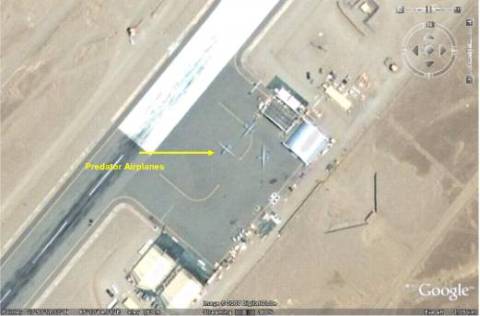
In a shocking discovery reports have emerged from simply Google Earth images evidence of three drones parked on an airfield in some remote destination within Balochistan, the images were captured by orbiting satellites and archived within Google Earth data warehouse to suddenly be discovered recently. Though there is no denying that during the Musharraf regime bases were rented out to the American army costing them a massive deficit to the tune of $10 Billion. But what probably irks the nation is that the Pakistani government has categorically denied that the Pakistani bases are being used to launch drones-
The picture of the drones on the Pakistani soil, taken in 2006, has three drones, all Global Hawks. The picture has coordinates and they can be vaguely read as 27 degrees, 51 minutes North; 65 degrees, 10 minutes East. These coordinates place the strip not far from the nearby Jacobabad airbase which is around 28 degrees north, 68 degrees east.
One can easily verify the authenticity of the picture taken in 2006 with the 2009 image found online on Google Maps by merely inserting the above coordinates [or follow this LINK] in satellite mode
The Times Online also carried the report
The CIA is secretly using an airbase in southern Pakistan to launch the Predator drones that observe and attack al-Qaeda and Taleban militants on the Pakistani side of the border with Afghanistan, a Times investigation has found. The Pakistani and US governments have repeatedly denied that Washington is running military operations, covert or otherwise, on Pakistani territory — a hugely sensitive issue in the predominantly Muslim country.
The Pakistani Government has also repeatedly demanded that the US halt drone attacks on northern tribal areas that it says have caused hundreds of civilian casualties and fuelled anti-American sentiment. But The Times has discovered that the CIA has been using the Shamsi airfield — originally built by Arab sheikhs for falconry expeditions in the southwestern province of Baluchistan — for at least a year. The strip, which is about 30 miles from the Afghan border, allows US forces to launch a Drone within minutes of receiving actionable intelligence as well as allowing them to attack targets further afield
But it all started a few days earlier when Sen. Dianne Feinstein (D-Calif.), chairwoman of the Senate Intelligence Committee commented on 13th of February that unmanned CIA Predator aircraft operating in Pakistan are flown from an air base in Pakistan. The disclosure also marked the first time a U.S. official had publicly commented on where the Predator aircraft patrolling Pakistan take off and land.
The CIA declined to comment, but former U.S. intelligence officials, speaking on condition of anonymity because of the sensitivity of the information, confirmed that Feinstein’s account was accurate.
While Bruce Hoffman, a terrorism expert at Georgetown University, said Feinstein’s comments put Pakistan’s government on the spot.
If accurate, what this says is that Pakistani involvement, or at least acquiescence, has been much more extensive than has previously been known,” he said. “It puts the Pakistani government in a far more difficult position [in terms of] its credibility with its own people. Unfortunately it also has the potential to threaten Pakistani-American relations.
The cat is out of the bag. So that is once more proved that how much regard American and our own government has for the people who reside in Pakistan. Their lives are of no value and our own government is involved in the killings. What a shame and what a sorry state of affairs. Another lie of our president has been caught and nobody knows how many more are on the way
For now the Government of Pakistan has a lot of explaining to do and just mere diversion tactics towards Musharraf might alone not help their case.
Why does Geo collude with foreign media?
Why does it focus on creating chaos and general discontent?
Why does it act like an instrument of an political party?
Why does Geo behave like the arm of a foreign force?
Why did Geo deliberately broadcast false bad news about the economy when the stock market was booming?
What hand did Geo play in scaring the foreign investors away from Pakistan?
Why did Geo repeat the false news about the growth figures which led to the crash of the stock market?
Why does Geo show wrong Pakistani maps?
Why does Geo almost never cover the insurgencies in India?
Why is Geo so infatuated with Anti-Pakistan Bollywood films?
Why is Geo bent upon creating a “Indianization” of Pakistan?
Why does Geo pay so much attention to Bollywood?
Why does Geo show dead bodies? Is this all part of a psy-op or is it part of an agenda?
Why does Geo generally show the Indian version of events and why does its news sound like a translation of CNN news?
Why did Geo not focus on showing 250 million people sleeping on sidewalks in India?
Why is Geo not reporting Gen. Kayani’s statement that he suspects a foreign hand in the assassination to destabilize and denuclearize Pakistan? The silence is deafening!
“Why does Geo almost never cover the insurgencies in India?
Why is Geo so infatuated with Anti-Pakistan Bollywood films?
Why is Geo bent upon creating a “Indianization” of Pakistan?
Why does Geo pay so much attention to Bollywood?”
Mr Husain Haqqani of the Hudson institute is on the payroll of JINSA and AIPAC (public information posted on Rupee News) is a known neocon with his own agenda. His wife Ms. Isphani is involved with VOA and Geo pursuing the same Neocon agenda.
A company is known by the company it keeps. Geo certainty deals with some “colorful” characters. Its genesis, consultants, and affiliations leave much to be desired.
We have attempted to put together a thesis and a case on why Geo has exacerbated the conditions in Pakistan and why it is biased. We discuss the origins of Geo and its connections with shady operatives. The information on the CIA psy-ops discusses how the CIA operates in other countries.
Geo has connived with shady characters who are associated with foreign powers. Geo’s track record in showing dead bodies, and repeating nonsense on the economy, and providing place and comfort to the enemy.
Geo employs a lot of good reporters, but it also employs program hosts whose credentials and loyalty to Pakistan is questionable. For example, Mr Shaharyar Azhar is a known follower of Neocon philosophy and ideas always highlighting the negative news about Pakistan and not taking India or other countries to task. There are reports in the press that Geo has been instrumental in the campaign of disinformation about Pakistan. It has become a willing or unwilling instrument of those who wanted to destabilize Pakistan.
The Government of Pakistan and the ISI got wind of Geo plans and recommended to the President to take action against Geo. The Emergency imposed by the previous government was to thwart the campaign of disinformation that was running concurrently by Time magazine and Newsweek Magazine and the Neocon News agencies in the West.
Geo’s dangerous general policies are the main reason that the Pakistan was not allowing Geo to resume its transmission. Amazingly Geo is now starting a new “English News” channel to continue its activities against the country. Where is the funding for all this coming from?
Whether Geo is an unwilling victim of its sponsors and her affiliates in the USA or India, or is Geo running a planned campaign and got caught with its pants down.
Some facts about Geo, and some example of how Geo demorolizes the population and the general body of the Pakistani dispora.
GEO IS RESPONSIBLE FOR THE CRASH OF THE STOCK MARKET: Geo repeatedly telecasted false news about the Pakistani economy, the political situation and hence the stock market crashed in Pakistan In a pre-orchestrated campaign.
Geo focuses on the negative news and instead of focusing on solutions it shows bodies of dead people in contradiction of PEMRA and all decency requirements.
Geo focuses on petrol prices but does not inform the viewers that most private cars in Pakistan now run on CNG (liqufied petroluem gas) which costs $5 for a tank full. Most people driving cars are not affected by the rise in petrol (gasoline) prices.
In a planned manner Geo suppresses and ignores good news like 5.1 billion dollar of oil refinery in Pakistan
Geo usually ignores good news like $28 Billion Emar international island development
Geo is averse to good news about Pakistan–there is no discussion of the Bullet Trains in Pakistan.
Geo does not focus foreign interference in Pakistani affairs.
Geo did not discuss the 89 separatist movements in India in 2007 …from Seven Northeastern sister states, to the Naxalite insurrection, to Bihar to Kashmir, to Assam etc…
Geo Dramas: 50 percent of the dramas are Indian dramas on Geo and 25 percent are with mix cast (Indian and Pakistani) and Indian film
Geo focuses on showing beheading of people and other depressing news.
Geo did not cover for 36 hours the killing of 3000 Muslims in Gujrat?
Urdu is not used by many hosts. Morning host shows are in English and “Urdlish” (a horrible combination). The younger generation is being spoiled by using them as instruments of hedonism.
Some of the shows are way beyond the pale on being modern. Nudity is not modernity. Science and Technology is modernity.
Geo plays into the hands of the opposition parties. It does not discuss opportunities for development.
When Mr Shaharayar interviewed the President of Azad Kashmir, he interrupted him and did not allow him to speak about the problems with the article of accession of Kashmir to India (which is now lost) if it ever existed.
Geo continues to use Indian jargon like “partition”. Partition signifies a temporary dissection of the whole. India was never whole. Even during British times there were more than 500 states in the Subcontinent. Some of them banded together to make Pakistan and others banded together to make India.
Discussion of Kashmir, Manvanagar, Junagarh are non-existent on Geo. Most Geo maps show Kashmir as part of Pakistan. Azad Kashmir is never shown. Some Geo maps sill show the Nothern Areas as part of India or part of Kashmir.
Kamran Khan was getting Rs 25 lakh per month. Income vs. salary?
Dr Shahid Mahmud used to get Rs 22 laks per month. He was a member of NSF student.
Hamid Mir the Editor of “Ausaf” get Rs. 22 Lakh per month.
Nadia Khan gets Rs 6 lacs per month. Income vs. salary?
When Geo was not able to broadcast the 8-hour cricket match, Geo said they lost 1 billion Rupees, After the ban Goo kept on broadcasting for 36 hours without any income?Let us investigate the players involved with Geo from information that is publicly available. We see these links which will be analyzed.
Geo was started with the help of an ex US Naval Petty Officer by the name of Hazinski who has links with Mr. Casper Weinberger and many Indian channels.
According to (http://www.intelligentmc.com/people.html) “Most recently, he re-designed the central International Broadcast Center for the Voice of America in Washington and is consulting on new network launches for the VOA”. Mr Hazinski is the principal of the company called IntelligentMC (http://www.intelligentmc.com/Welcome.html,2870 Peachtree Road #713, Atlanta, GA 30305-2918, USA, email: info@intelligentmc.com, url: http://www.intelligentmc.com).the other principal of Intelligent MC is Mr. Todd Frantz. “Todd comes to IMC from 10 years at CNN in Atlanta”. He has links to “Cox Center for International Mass Communication Training and Research at The University of Georgia”
David Hazinski, associate professor at the University of Georgia’s Grady College of Journalism and Mass Communication, is the principle architect of GEO-TV and managed the station’s launch. Hazinski was contacted by the Jang Group, Pakistan’s largest newspaper publisher and GEO-TV’s owner, after he shepherded the successful launch of a similar station in India in January 2001. Aaj Tak, the first all-news, Hindi-language channel in India, now has a 60% share of the news audience in India.
As one of the owners of Intelligent Media Consultants, an Atlanta-based company that helps its clients design efficient and profitable network operations through the creative application of broadcast technology, Hazinski has worked all over the world launching news operations in markets starved for unbiased reporting. “This is really the cutting edge of technology and journalism,” says Hazinski, a former NBC news correspondent who says he and his partners have helped launch at least a dozen news operations in the last 10 years. “These are new markets. They haven’t been exposed to lots of TV.”
Because most of Intelligent Media’s clients are unfamiliar with broadcast news techniques, Hazinski says he is able to tailor unique approaches that maximize their limited budgets. “These people are willing to try new things because they don’t want to pay the outrageous costs associated with news production in the United States,” he says. “Right now, based on what we learned in Pakistan, we’re convinced we can launch a network today for half of what it would have cost three years ago. And no one would see any quality difference on the air – even if we aired it in the U.S.”
At GEO-TV’s main broadcast center in Karachi, Hazinski built a newsroom around 24 Mac G4s running Final Cut Pro. News footage is captured with 40 Sony PD150s and 15 PD100s. NewTek Video Toaster 2 systems are used at bureaus in Islamabad and Lahore to switch between the main broadcast center.
In addition to designing a systems approach for GEO-TV, Hazinski helped teach the station’s staff how to use the equipment and how to produce television news. Greg Pope, a freelance editor and producer formerly with CNN, spent one month in Karachi this summer training GEO-TV’s news staff, which primarily consists of newspaper journalists. “We basically had to convert people from print journalists to TV journalists,” says Pope, adding that he had never taught production techniques in a classroom setting to non-English speaking students. “These print people were basically issued cameras and editing equipment and within months were transformed from pen and paper to this new electronic media. Some of them didn’t even know how to use a keyboard when we started.”
Considering the steep learning curve for the Pakistani journalists, Pope says he was amazed at their perseverance and enthusiasm. “These people are tired of having Western news and government news shoved down their throats,” says Pope, who estimates that he taught 100 people to shoot and edit video. “They want their own voice. They want to represent themselves in their own way.”
But there is still a chance that the government will shut down GEO-TV. Pope says that while he was training the news staff, it was widely believed that there were spies for PTV within their ranks. However, in recent years the Jang Group has won many battles for freedom of the press, so there is hope that GEO-TV will succeed. “If they have minimal government interference, [GEO-TV] will change the face of Pakistan,” says Pope.
Geo has been blamed for participating in and highlighting events per CNN instructions.
Saboteurs trained in Afghanistan have been inserted into Pakistan to aggravate extremist passions here, especially after the Red Mosque operation.
Chinese citizens continue to be targeted by individuals pretending to be Islamists, when no known Islamic group has claimed responsibility. . A succession of “religious rebels” with suspicious foreign links have suddenly emerged in Pakistan over the past months claiming to be “Pakistani Taliban”. Some of the names include Abdul Rashid Ghazi, Baitullah Mehsud, and now the Maulana of Swat. Some of them have used, and are using, encrypted communication equipment far superior to what the Pakistani military owns.
karachi-partyVOA Launches Urdu TV For Pakistan, 11/13/2005
Washington, D.C. – The Voice of America (VOA) will launch Beyond the Headlines-its new television program in Urdu-on Monday, Nov. 14. The half-hour program will air on GEO TV in Pakistan at 7:30 p.m. Monday through Friday and on selected international satellites, including AsiaSat (Virtual Channel 409) and IOR (Virtual Channel 420).
Beyond the Headlines (Khabron se Aage), a fast-paced, contemporary production designed with young and urban Pakistanis in mind, will continue VOA’s 63-year tradition of broadcasting accurate and balanced information. Programs will examine international developments, technology, politics, social issues, education, religion, sports, and entertainment.
“We look forward to opening this important new channel of communication between the American people and Pakistan,” said Steven J. Simmons, a member of the Broadcasting Board of Governors (BBG), which oversees all United States international radio and television services. Simmons is chairman of the BBG’s Voice of America Committee, and has played a key role in increasing radio and TV service to Pakistan, including Beyond the Headlines.
“We’re particularly delighted with our partnership with GEO TV, the leading cable/satellite broadcaster in the Urdu language,” Simmons added. “This new program, together with our expanded radio service, demonstrates our growing commitment to reach the people of Pakistan with new, engaging programs on both radio and TV.”
“The links between Pakistan and the United States are strong and growing, and our new show is a reflection of that,” said VOA Director David S. Jackson. “Beyond the Headlines will focus not only on the big issues of the day, but also on features, business, and culture stories that illuminate the world we live in. For example, we’ll show how Pakistanis live and work and go to school in the U.S. We want to provide a unique mix of stories that viewers can’t find anywhere else.”
Farah Ispahani is the managing editor and executive producer for Beyond the Headlines. She joined VOA earlier this year, bringing more than 20 years of experience in print and television media at such news organizations as CNN, ABC, and NBC. Before she joined VOA, Ispahani, who is a fluent Urdu speaker, was instrumental in the launch of CNN’s Paula Zahn Now and Anderson Cooper 360.
Anchoring Beyond the Headlines will be Aneka Osman. A familiar face to Pakistanis, Osman worked as an English language news anchor on Pakistan Television. She has covered regional and national security issues, Pakistan-India relations, the conflict in the Middle East, and Pakistan’s general elections. She has also worked on Prime Television, the UK-based Pakistani channel, and on the Business Plus Channel.
Ayaz Gul is VOA Urdu’s Chief Reporter and Pakistan Coverage Coordinator for Radio Aap ki Dunyaa (Your World Radio), VOA’s Urdu radio service, and Beyond the Headlines. Gul, who is based in Pakistan, has been filing on-the-scene reports in Urdu and English for VOA since 1996, and his reports are translated into numerous languages throughout VOA. Prior to joining VOA, he worked for the Japanese network NHK and for the German news agency DPA as a reporter specializing in Pakistan’s foreign and domestic news.
VOA’s Urdu Service broadcasts 12 hours a day of news and information to millions of Pakistanis and other Urdu speakers on Radio Aap ki Dunyaa. The program is distributed by medium wave at 972 kHz, digital audio satellite, the Internet and a three-hour shortwave broadcast. The launch of Beyond the Headlines adds two-and-half hours of television to the Urdu Service’s weekly broadcast schedule.
The Voice of America, which first went on the air in 1942, is a multimedia international broadcasting service funded by the U.S. government through the Broadcasting Board of Governors. VOA broadcasts more than 1,000 hours of news, information, educational, and cultural programming every week to an estimated worldwide audience of more than 100 million people. Programs are produced in 44 languages.
CIA Director Leon Panetta said on June 11 that Pakistan’s military offensive against the militants would help the United States catch Osama bin Laden who was still hiding in that country. Mr Panetta told reporters after a speech on Capitol Hill that finding Bin Laden remained one of CIA’s top priorities.
Fit Chile 2The combination of increased CIA activity and the Pakistani military offensive will give the United States a better chance of nabbing him, he added. Mr Panetta also indicated the possibility of conducting joint operations with Pakistani forces to catch Bin Laden and other senior Al Qaeda leaders.
In his speech, the CIA chief said his agency had increased the number of officers and agents in Pakistan and they were providing valuable information about the Al Qaeda network, particularly in Fata.
The agents, he said, had provided useful information about possible terrorist targets in Fata.
Asked whether he was sure that Bin Laden was in Pakistan, Mr Panetta said: ‘The last information we had, that’s still the case.’
US intelligence officials say that although the Al Qaeda reclusive leader has eluded a US manhunt since the September 11, 2001, he was not only alive but maintained some links with his top lieutenants as well.
‘Finding Bin Laden is one of our major priorities,’ Mr Panetta said. ‘One of our hopes is that the Pakistanis move in militarily, combined with our operations, we may be able to have a better chance’ to find the Al Qaeda leader, he said.
Mr Panetta said Al Qaeda ‘remains the most serious security threat’ to the United States and its leaders and continued to plot against America.
Besides Pakistan, he said, his agency was also focussing on countries where Al Qaeda might find safe haven, like Somalia and Yemen.
Permalink Leave a Comment
Was Benazir Working for the Americans?
March 14, 2009 at 12:29 pm · Filed under CIA, Dr Qadeer Khan, PPP ·Tagged Benazir Bhutto, CIA, Pakistan, Pakistani Politics
bilawal4By Dr Sachithanandam Sathananthan,
The author earned his Ph.D. from the University of Cambridge. He serves as a Visiting Research Scholar at the Jawaharlal Nehru University School of International Studies.
Sep 12, 2008
There is great euphoria among Pakistani liberals over the presumed ‘return to democracy’. They are yet to discover Late Neo-colonialism. The manoeuvres against Musharraf bear uncanny resemblances to organised ‘people’s power’ the CIA unleashed during ‘colour revolutions’ and upheavals against Hugo Chavez.
The widely expected victory for PPP leader Asif Ali Zardari in the presidential election brought to a high point the tortuous process of regime change in Pakistan. Anyone who has followed the ‘colour revolutions’ that installed pro-American rulers in Georgia (Rose Revolution, 2003), Ukraine (Orange Revolution, 2004) and Kyrgyzstan (Tulip Revolution, 2005) could surely not have missed the tell tale signs.
The earliest foreboding surfaced in the backroom manoeuvres by United States (US) and British intelligence services to engineer panic about the security of Pakistan’s nuclear assets. It was a repeat of the duplicitous hysteria they generated over non-existent weapons of mass destruction that Iraq allegedly possessed. A carefully worded article, co-authored by former State Department officials Richard L. Armitage and Kara L. Bue, signalled the shift in US policy. After formally acknowledging then President Pervez Musharraf’s many achievements, the authors continued: ‘much remains to be accomplished, particularly in terms of democratization. Pakistan must…eliminate the home-grown jihadists…And…it must prove itself a reliable partner on technology transfer and nuclear non-proliferation.’ And the denouement: ‘We believe General Musharraf…deserves our attention and support, no matter how frustrated we become at the pace of political change and the failure to eliminate Taliban fighters on the Afghan border.’
Translation: Musharraf has to go.
Almost simultaneously a 2006 country survey in The Economist, titled ‘Too much for one man to do’, began on a jingoistic overkill: ‘Think about Pakistan, and you might get terrified. Few countries have so much potential to cause trouble, regionally and worldwide’. The following year a Carnegie Endowment report faulted western governments that ‘contribute to regional instability by allowing Pakistan to trade democratisation for its cooperation on terrorism’. Senior US State Department officials repeatedly accused Musharraf of ‘not doing enough’ to combat Islamists within Pakistan and prevent their infiltration across the Durand Line into southern Afghanistan.
12novbb_sletterSensing the way wind was blowing, then Benazir Bhutto redoubled efforts to convince Washington and London that, if she were to become Prime Minister, she would gladly do their bidding. She underscored her enthusiasm to serve and ensured her party was fully responsive to America’s Late Neo-colonialism. She summoned senior party members to Dubai on 9 June 2007 for a ‘briefing’ by a team from the US Democratic Party’s National Democratic Institute (NDI), ostensibly on the subject of elections in Pakistan. The ruling Republican Party’s International Republican Institute (IRI) had conducted the previous four ‘briefings’ in June and September 2006 and March and April 2007. Benazir leaned towards the Democratic Party in the last one no doubt as a hedge against the party’s possible victory at the forthcoming US Presidential Election.
Even a cursory knowledge of US Imperialism’s standard operating procedure is sufficient to surmise at least some among the IRI and NDI officers were covert intelligence operatives; and that their ‘briefings’ went beyond ‘tutelage of natives’. Rather they have been grooming the PPP as America’s satrap.
Benazir’s predilection to collaborate with the West has its roots in the Bhutto family’s micro political culture. Her grandfather, Shah Nawaz Bhutto was a minor comprador official in the British colonial regime. The British rewarded his ‘loyal’ services with the title Khan Bahadur and later appointed him President of a District Board and still later elevated him to knighthood.
Her father Zulfikar Ali Bhutto’s populist programmes did not dilute that legacy, which left a lasting impression on Benazir; she firmly believed the path to political power in Pakistan meanders through the Embassy of the United States, the current neo-colonialist.
She promised to offer the International Atomic Energy Agency access to Dr Abdul Qadeer Khan to ’satisfy the international community’, an euphemism for the major powers; and to allow the US-led International Security Assistance Force in Afghanistan to operate inside north-western Pakistan. By the time Benazir visited the Senate in September 2007, she had convinced the Bush Administration of her unswerving loyalty; for ’she received a standing ovation from a select gathering of US lawmakers, diplomats, academics and media representatives. This contrasted sharply with her previous visits to the US capital when she received little attention.’ To deepen ‘Washington’s renewed interest in her, Benazir cautioned that supporting Musharraf was ‘a strategic miscalculation’ and pleaded ‘the US should support the forces of democracy’, which, of course, refers to her PPP.
So, President George W Bush enabled Benazir’s return from exile by arm-twisting Musharraf to promulgate the National Reconciliation Ordinance (NRO). The NRO of 5 October granted amnesty to politicians active in Pakistan between 1988 and 1999 and effectively wiped the slate clean of corruption charges for Benazir and her husband Asif Zardari. Three weeks later Secretary of State Condoleezza Rice made it appear the Bush Administration wished to bring together ‘moderate’ forces, implying a scenario in which Musharraf and Benazir would join forces as President and Prime Minister respectively; and Deputy Secretary of State John Negroponte corroborated Rice: ‘Our message’, he intoned, ‘is that we want to work with the government and people of Pakistan’.
However, Musharraf saw through the US Administration’s transparent ploy to lull him into believing it would not remove him and install Benazir in his place. So, he swiftly invited Nawaz Sharif, leader of the Pakistan Muslim League-Nawaz (PML-N), back from exile in Saudi Arabia to counter Benazir. But he could not consolidate his position, especially because he mishandled the judiciary, and was compelled to resign on 18 August 2008.
In a nutshell, the reason for ‘Washington’s renewed interest’ in Benazir is Musharraf’s firm opposition to US Late Neo-colonialism, to its manoeuvres to occupy, pacify and ravage Pakistan. In the 19th century British colonialism waged the ‘war on piracy’ on the high seas ostensibly to bring ‘the light of Christian civilization’. But the British were the most successful pirates, as Spanish and Portuguese historians would gladly confirm. The ‘war on piracy’ was the duplicitous justification trotted out to dominate lucrative maritime trade routes that were in the hands of Chinese, Arab and Tamil maritime empires and to invade kingdoms and/or countries essential to control trade and plunder resources. During most of the 20th century heroic anti-colonial movements and anti-imperialist wars rolled back much of colonial rule, which in some instances however morphed into neo-colonialism. Indonesia after Sukarno, Iran after Mosaddeq and Chile after Allende are well known examples.
The ‘war on terror’ and ‘promoting democracy’ are the 21st century equivalents of the 19th century British gobbledygook. American Late Neo-colonialism purveys them as moral justification and uses as political cover for intervening and, where necessary, invading resource-rich and strategic countries to overthrow nationalist leaders, install puppet regimes and savage the countries’ wealth. And of course the US is by far the most powerful terrorist force.
It succeeded in Iraq (for now); but the CIA-organised regime change could not dislodge Venezuela’s Hugo Chavez, who rejected the neo-colonialist 1989 Washington Consensus and supported alternative nationalist economic models.
Politically challenged Pakistani liberals — a motley crowd that includes members of human rights and civil liberties organisations, journalists, analysts, lawyers and assorted professionals — are utterly incapable of comprehending the geo-strategic context in which Musharraf manoeuvred to defend Pakistan’s interest. So they slandered him an ‘American puppet’, alleging he caved in to US pressure and withdrew support to the Afghan Taliban regime in the wake of 9/11 although in fact he removed one excuse for the Bush Administration to ‘bomb Pakistan into stone age’, as a senior State Department official had threatened.
Nevertheless American discomfort with Musharraf’s government was palpable by late 2003, after he dodged committing Pakistani troops to prop up the Anglo-American invasion of Iraq. When he offered to cooperate under the auspices of the Organisation of the Islamic Conference (OIC), naïve Pakistani media and analysts lunged for his jugular, condemning him once again for succumbing to US demands. But in fact he nimbly sidestepped American demands: he calculated that diverse ideological stances of the 57 Muslim member-counties would not allow the OIC to jointly initiate such controversial action and therefore Pakistan’s participation cannot arise, which proved correct.
Washington of course was not amused and the Bush Administration grew increasingly hostile to Musharraf’s determination to prioritise Pakistan’s interests when steering the ship of the state through the choppy waters of the unfolding New Great Game, in which the West — led by the US — is manoeuvring to contain growing Russian and Chinese influences in Central and West Asia. His foreign policy decisions over time convinced Washington that under his leadership, Pakistan would side with enemies of US and Britain in the New Great Game. First, he refused to isolate Iran; instead he vigorously pursued energy cooperation to build the Iran-Pakistan-India gas pipeline in the face of stiff American opposition. Second, Washington was alarmed by Musharraf’s preference for deepening Pakistan-China bilateral relations and forging nuclear cooperation; and more so when he offered Beijing naval facilities at the Gwadar port on Balochistan’s Arabian Sea coast overlooking the entrance to the Strait of Hormuz, a strategic chokepoint through which passes approximately 30 per cent of world’s energy supplies.
Perhaps the last straw was his success in gaining Observer Status for Pakistan in the Shanghai Cooperation Organisation (SCO). Russia and China are spearheading the SCO, which includes four other countries: Kazakhstan, Kyrgyzstan, Tajikistan and Uzbekistan; Iran and India are also Observers. The SCO is widely perceived as a rising eastern counterweight to western security and economic groupings and Islamabad drifting towards the SCO was simply unacceptable in Washington.
To rub salt into its wounds, Musharraf refused permission to interrogate Dr. AQ Khan and firmly rejected Washington’s demands that NATO troops be allowed into the North West Frontier Province (NWFP) to hunt down Osama bin Laden and his associates.
By early 2006 it was clear Washington was looking for nothing less than a pliable leader in Islamabad, a firm political foothold in Pakistan and a Pakistani foreign policy that complemented US strategic aims in Central Asia.
What perhaps angered Washington the most were actions Musharraf took to wind down the ‘war on terror’ within Pakistan.
Immediately after taking power, he outlawed three Islamic extremist groups and, after 9/11, intensified military operations in the Federally Administered Tribal Areas (FATA) bordering Afghanistan.
Washington would have gone along with Musharraf had he focussed on military operations to curb Islamists. Military action alone cannot defeat guerrillas; but it can kill many of them and in turn induce new recruits — well known points reiterated by William R Polk in Violent Politics (2007) – so that the so-called ‘war on terror’ would not end any time soon.
That could supplement US Administrations’ assiduous manufacture of the ‘Islamic threat’ through the 1990s to launch an endless ‘war on terror’ — the New Cold War — to rescue America’s permanent war economy. For after the collapse of the Soviet Union, the US economy (and by extension west European economies) faced perhaps its biggest crisis: the ‘Communist threat’ ceased to be credible; it could not be exploited to terrify the American people into acquiescing to rising military expenditure that keeps wheels of the permanent war economy rolling and to expanding the repressive security apparatuses.
So the Bush Administration deftly replaced the ‘Communist threat’ with the ‘Islamic threat’, no doubt following Machiavelli’s famous advice in The Prince, that a wise ruler invents enemies and then slays them in order to control his own subjects. The apparently counterproductive bombings, arrests, torture, kidnappings and disappearances (sanitised as Extraordinary Rendition) carried out by US forces while the CIA covertly funded, armed and supported Islamists are intended not to eliminate the ‘Islamic threat’ but to contain it within manageable limits and to spawn the next generation of ‘terrorists’.
Sometimes, plans go awry; ‘culling’ may not contain the resistance, as seen in Afghanistan from time to time. Nevertheless, the strategy is to ‘feed terrorism’ and simultaneously ‘cull terrorists’ so that the perpetual New Cold War oils America’s moribund permanent war economy.
Musharraf, however, did not play ball. He complemented military force to defeat Islamists with political initiatives.
He signed a peace treaty with tribal elders in North Waziristan (within FATA) to marginalise the Islamists. To combat the Islamists’ religious ideology, he promoted ‘enlightened moderation’, a veiled reference to secularism and tolerance. Musharraf’s vision of a secular Pakistan has its roots in exposure to Mustafa Kemal Ataturk’s legacy when he attended school in Ankara during his father’s diplomatic posting to Turkey. In fact, after taking power in Pakistan he often held up Ataturk as his role model. He planned to ‘wean away’ the people from the ‘extremists’ through education is how he described his approach to this writer. Towards this end, he introduced educational reforms and re-wrote school history text books; enacted laws protecting women’s rights and diluted Islamic laws against women; and he liberalised the media. To deny Islamists their traditional rallying cry — Kashmir — he opened path breaking negotiations with India to remove that arrow from the Islamists’ quiver.
When Musharraf skilfully combined military operations against Islamists with a political front promoting secularism to ideologically disarm them, the US administration saw red. By secularising Pakistani society over time Musharraf would de-fang the ‘Islamic threat’ within Pakistan and extricate the country out of the contrived orbit of ‘war on terror’.
That would greatly diminish Washington’s leverage to intervene in the country to distance Islamabad from Beijing and exploit energy resources abundantly found in Balochistan and, in the long run, perhaps derail US administration’s well laid plans to bring Afghanistan to heel and to dominate Central Asia and its oil-rich Caspian Sea basin.
But Musharraf was in no mood to back down. So the Bush Administration slipped regime change into gear. Taking advantage of his missteps, the anti-Musharraf media blitz, NGO and student mobilisations, lawyers agitations, protests by political parties and civil society organisations seemingly coming from all directions in fact displayed a fantastic degree of organisation, coordination and financing clearly beyond the ken of the fratricidal activists and often ad hoc institutions and never witnessed before in the country. Very likely they will not be seen again either; indeed later the activists were singularly incapable of organising any significant agitation when three women were buried alive for defying their parents’ choice of husbands. The manoeuvres against Musharraf bear uncanny resemblances to organised ‘people’s power’ the CIA unleashed during ‘colour revolutions’ and upheavals against Hugo Chavez.
The Bush Administration began reaping the rewards of unseating Musharraf within 24 hours of his resignation. Chief of Army Gen Ashfaq Parvez Kayani travelled to Kabul to meet NATO and Afghan commanders on 19 August. About 10 days later Chairman of the US Joint Chiefs of Staff Admiral Mike Mullen informed a Pentagon news conference on 28 August that Kayani and his lieutenants held a ’secret meeting’ with their US counterparts on a US aircraft carrier, reminiscent of American gun boat diplomacy in Latin America and unthinkable in Pakistan under Musharraf’s watch..
Mullen touchingly chronicled how he ‘learned to trust’ Kayani and bent over backwards to emphasise that Kayani is no American puppet, that Kayani’s ‘principles and goals are to do what’s best for Pakistan.’ But a few sections of the US media, weaned on decades of Pentagon-speak from the debacle in Vietnam to the illegal invasion of Iraq, saw through the verbal obfuscation. And when a reporter pointedly queried Mullen whether Kayani’s ‘goal for Pakistan also aligned a hundred per cent with the US goal’, the Admiral waffled: ‘[Kayani] knows his country a whole lot better than we do. And again, I just think that’s where he is, that’s where he’ll stay.’ Translation: US administration has got Kayani on tight leash.
And to maintain there is no substantial change from Musharraf’s policies, Kayani’s spokesman Maj-Gen Athar Abbas and Mullen alleged the meetings had been arranged several weeks earlier, when Musharraf was President, to facetiously imply he had approved the contacts.
The import of ‘coordination’ between American, NATO, Afghan and Pakistan militaries will become clearer over the next weeks and months. For now the suspicion is unavoidable that the US Administration has at long last begun frog-marching Pakistan into the US-created Afghan quagmire to further destabilise the country and justify intervention.
Musharraf had resolutely opposed precisely this eventuality. He rejected US demands that the Pakistani army assist NATO forces in Afghanistan. He underlined the country will not repeat the catastrophic mistakes of the 1980s when it got embroiled in America’s war in Afghanistan against the then Soviet Union, for which the Pakistani people continues to pay a heavy price. Rather, he insisted his army will fight only Pakistan’s war within Pakistan’s borders.
The consequences of the PPP leadership following the US into the Afghan quagmire will soon be evident. Already, within 16 days of Musharraf’s resignation, US forces carried out the first ground assault in Angoor Adda area within Pakistan’s borders — which Musharraf had disallowed — with the connivance of the new leadership. Obviously there is more to come since the Bush Administration has eagerly caricatured the Pakistan-Afghanistan border as ‘The New Frontier’ in the New Cold War.
For the moment, there is great euphoria among Pakistani liberals over the presumed ‘return to democracy’. The comments by Ayesha Tanmy Haq are typical: ‘We have removed a dictator by the citizenry showing that real power lies with them.’ The hapless liberals have yet to discover Late Neo-colonialism and its devious manoeuvres for regime change; they have in fact effectively legitimised them by opposing Musharraf. They are agonisingly unaware of the labyrinthine geo-politics and economic imperatives underlying the New Cold War. They are blissfully going along with the collaborationist leaders who are bartering away the country’s future for the proverbial pieces of silver.

American officials say they are seeing the first evidence that dozens of fighters with Al Qaeda, and a small handful of the terrorist group’s leaders, are moving to Somalia and Yemen from their principal haven in Pakistan’s tribal areas.
In communications that are being watched carefully at the Pentagon, the White House and the Central Intelligence Agency, the terrorist groups in all three locations are now communicating more frequently, and apparently trying to coordinate their actions, the officials said.
Some aides to President Obama attribute the moves to pressure from intensified drone attacks against Qaeda operatives in Pakistan, after years of unsuccessful American efforts to dislodge the terrorist group from their haven there.
But there are other possible explanations. Chief among them is the growth of the jihadist campaigns in both Somalia and Yemen, which may now have some of the same appeal for militants that Iraq did after the American military invasion there in 2003.
Somalia is now a failed state that bears some resemblance to Afghanistan before the Sept. 11, 2001, attacks, while Yemen’s weak government is ineffectually trying to combat the militants, American officials say.
Small numbers
The shift of fighters is still small, perhaps a few dozen, and there is no evidence that the top leaders — Osama bin Laden and Ayman al-Zawahri — are considering a move from their refuge in the Pakistani tribal areas, according to more than half a dozen senior administration, military and counterterrorism officials interviewed in recent days.
Most officials would not comment on the record about the details of what they are seeing, because of the sensitivity of the intelligence information they are gathering.
Leon E. Panetta, the C.I.A. director, said in remarks here on Thursday that the United States must prevent Al Qaeda from creating a new sanctuary in Yemen or Somalia.
The steady trickle of fighters from Pakistan could worsen the chaos in Somalia, where an Islamic militant group, the Shabab, has attracted hundreds of foreign jihadists in its quest to topple the weak moderate Islamist government in Mogadishu. It could also swell the ranks of a growing menace in Yemen, where militants now control large areas of the country outside the capital.
“I am very worried about growing safe havens in both Somalia and Yemen, specifically because we have seen Al Qaeda leadership, some leaders, start to flow to Yemen,” Adm. Mike Mullen, the chairman of the Joint Chiefs of Staff, said in remarks at the Brookings Institution here on May 18.
Complicating American strategy
For the United States, the movement creates opportunities as well as risks. With the Obama administration focusing its fight against the Taliban and Al Qaeda on the havens in Afghanistan and Pakistan, a shift of fighters and some leaders to new locations could complicate American efforts to strike a lasting blow.
But in the tribal areas of Pakistan, Qaeda and Taliban forces have drawn for protection on Pashtun tribes with whom they have deep familial and tribal ties. A move away from those areas could expose Qaeda leaders to betrayal, while communications among militants in Pakistan, Somalia and Yemen have created a new opportunity for American intelligence to zero in on insurgents who gave up many electronic communication devices shortly after the Sept. 11 atta A senior Obama administration official attributed some of the movement to “the enormous heat we’ve been putting on the leadership and the mid-ranks” with Predator strikes, launched from both Pakistan and Afghanistan. Mr. Obama’s strategy so far has been to intensify many of the strikes begun under the Bush administration.
“There are indications that some Al Qaeda terrorists are starting to see the tribal areas of Pakistan as a tough place to be,” said an American counterterrorism official. “It is likely that a small number have left the region as a result. Among these individuals, some have probably ended up in Somalia and Yemen, among other places. The Al Qaeda terrorists who are leaving the tribal areas of Pakistan are predominantly foot soldiers.”
c Measuring the numbers of these movements is almost as difficult as assessing the motivations of those who are on their way out of the tribal areas.
But American officials say there is evidence of a shift. One senior American military official who follows Africa closely said that more than 100 foreign fighters had trained in terrorism camps in Somalia alone in the past few years. Another senior military officer said that Qaeda operatives and confederates in Pakistan, Yemen and Somalia had stepped up communications with one another.
“What really has us worried is that they’re communicating with each other much more — Al Qaeda in Pakistan, Somalia and Yemen,” the senior military officer said. “They’re asking, ‘What do you need? Financing? Fighters?’ ”
ks to avoid detection. Mr. Obama’s strategy for Afghanistan and Pakistan placed the defeat of Al Qaeda as the No. 1 objective, largely to make sure that the group could not plot new attacks against the United States.
Thus, the movement of the fighters, and the disruption that causes, has been interpreted by some of the president’s top advisers as a sign of success.
But the emergence of new havens, from which Al Qaeda and its affiliates could plot new attacks, raises difficult questions for the United States on how to combat the growing threat, and creates the possibility that increased missile strikes are in the offing in Yemen and Somalia.
“Those are issues that I think the international community is going to have to address because Al Qaeda is not going away,” Admiral Mullen told a Senate committee on May 21.
The C.I.A. says its drone attacks in Pakistan have disrupted Al Qaeda’s operations and damaged the group’s senior ranks. American officials say that strikes have killed 11 of the top 20 Qaeda leaders in the past year.