KARACHI: President Asif Ali Zardari said on Tuesday that Pakistan People’s Party was striving for a better future for the poor in concert with the coalition partners, and will go into the next elections on the basis of its performance.
Mr Zardari said the NFC award would be announced this year and decision about the future of the local bodies would also be taken shortly.
President Zardari expressed these views during exchanges with the media at Bilawal House.
He emphasised the need for giving more time to the government for clearing the mess of the past.
Responding to queries, Mr Zardari said the government had taken long-term measures for promoting trade and reducing reliance on aid.
He said that during his foreign tours and interaction with their representatives he had made it clear that his government believed in trade. He claimed the country was moving in the right direction.
About the federal budget, he said had the government not invoked the IMF option the meltdown effect would have been unbearable.
The president said that there was a lot of room to raise exports from a meagre 24 billion dollars to 200 billion dollars.
President Zardari said that democracy had been fostered in the country and Benazir Bhutto gave her life for the cause of democracy and he also went to jail for the cause of democracy.
He claimed that during 10 months public opinion around the world was swinging in favour of Pakistan especially after a consensus had been developed with regard to the war on terror and the people had started owning this war.
He said that with good wheat support price the government had managed to enhance its yield, but emphasised the need for adopting techniques to obtain higher per acre yield with less use of water.
In this context, he referred to deal with China for obtaining high yield seeds.
With regard to electricity, he pointed out that Benazir Bhutto during her government had come up with a good IPP policy for generating 14,000MW and out of that 4,000MW was installed as well however, the subsequent governments did not take advantage of this and there was a gap of electricity supply in the country.
About the performance of KESC, he said that during his previous visit he had held a meeting and that we were trying out and if it did not deliver then we would have no other choice but to take it over.
President Zardari said that he would announce a package for Lyari from where he was also elected in the past.
He said that after the budget session the prime minister would hold a meeting with the local government ministers of the provinces to decide about the local bodies system.
He said the PPP government was under pressure as the expectations of the people were so high who wanted jobs.
He said people did not expect the other political parties and that’s why the PPP was under pressure and we were trying our best to fulfil their expectations.

Zardari is about to face another crisis of credibility from his own family members. Even Bilawal Zardari, at this young age, may have to come in public and support his beloved Aunt Sanam Bhutto against his father’s claims of material and political inheritance of Benazir Bhutto.
bilawal3
A source close to an international interviewer Daphne Barak has confirmed that Sanam Bhutto has already spoken loud and clear about her brother-in-law, Zardari. Though the contents of this interview have not been revealed, sources close to Daphne Barak saud that “Zardari, who was elected, using his late wife’s legacy and the Bhutto family would be embarrassed by Sanam Bhutto’s cold and determined disclosures.”
The bold and sometimes angry remarks of Sanam Bhutto may create such controversy that Bilawal Bhutto, at this young age, may have to take his own stand in this dispute. Very likely, he will support his favorite aunt Sanam Bhutto against his father, with whom he is already at odds on certain issues after her mother’s death.
Sanam Bhutto does not want to see Bilawal’s studies disturbed, but she also does not want to see the welfare of three young children of her sister being compromised. She has spoken as time is running out. Moreover, Sanam has been upset with Zardari’s handling of the PPP that is the most precious political legacy of her father Zulfikar Ali Bhutto and her sister Benazir Bhutto. He betrayed her sister’s promises to the nation about restoration of judges, caused political friction to the point that led Pakistan to the brink of civil war and caused historic damage to the popular Pakistan People’s Party to the maximum extent. Reportedly Sanam Bhutto has said, “My father, my brothers, my mother all of us suffered and made sacrifices for PPP and Asif Zardari has usurped it. He has made this party unpopular by his acts, purging of loyalists and politically seasoned elements, betraying the pledges and goals defined by Benazir Bhutto.”
In addition to political legacy of Benazir Bhutto, some issues of properties and financial fortunes are also cause of friction. Sanam Bhutto is acting as the watchdog of Bilawal, Bakhtawar and Assefa’s interests and is concerned that other members of Zardari family are working to derive benefits.
Daphne Barak and Benazir Bhutto have been friends for over 15 years and had very close relationship. She has insight into Benazir-Zardari relationship during the last 12 years. She is an insider of Bhutto family on many issues.
Ms Barak is going to be one of the first witnesses before the UN Commission to investigate the murder of Benazir Bhutto. She has already been invited by the UN officials for help and Daphane Barak has provided all her record, notes and recordings of Benazir Bhutto to the Chairperson of this Commission.
The UN secretary-general has yet not announced the name of the third member of this UN Commission while Chile’s ambassador to UN has been designated as the chairman.
It was slightly disconcerting to hear Richard Holbrooke, one of America’s best diplomatic negotiator, deploying words like “extraordinary” and “unprecedented” to describe the recent round of talks with delegations from Afghanistan and Pakistan in Washington, during a White House briefing for columnists just after the talks ended. He was flanked by General David Petraeus, who reinforced Holbrooke’s message. The talks “exceeded my expectations,” the general said. A good deal of this is, obviously, puffery designed to keep the diplomatic balloon aloft. But there was also, I’d guess, some wishful thinking involved.
For the first time, Afghan and Pakistani Ministers of the Interior sat down and hammered out a rudimentary agreement on information-sharing. Agricultural and trade delegations also met, as did, most significant of all, military and intelligence representatives. (The idea that the Afghan intelligence service would break bread with the Pakistani Inter-Services Intelligence directorate, which created the Taliban, is mind-boggling.) These advances were given greater heft by positive developments on the ground — especially Pakistan’s apparent decision to stop the Taliban advance toward Islamabad, using six to eight brigades transferred from the Indian border.
And yet, the rude truth of the situation in Afghanistan and Pakistan was revealed at a lunch the Presidents of both countries attended with 27 U.S. Senators, an event that really did merit a few over-the-top encomiums like “unprecedented” and “brutal.” The climax came when Senator Bob Corker of Tennessee asked President Hamid Karzai of Afghanistan what the purpose of the U.S. mission was in his country. Karzai filibustered, and Corker told him, in no uncertain terms, that his answer was incomprehensible. At a Senate Foreign Relations Committee hearing a few days later, Corker confronted Holbrooke about the lack of credibility both Presidents shared. According to the Obama Administration, Corker said, the Karzai government “is taking more of the illegal [poppy crop] moneys than the Taliban …” In Pakistan, “the leader was formerly called ‘Mr. 10%,’” referring to Zardari’s alleged practice of taking kickbacks on contracts when his wife Benazir Bhutto was in charge.
Indeed, neither President is exactly a paragon of statesmanship. The reality in Afghanistan and Pakistan is that both governments have been unable to provide the most basic services — security, education, justice — for their citizens, which is why the Taliban, which has some fairly strong ideas about law and order, has been able to intimidate its way back into control of some areas. Karzai has an excuse: his country has suffered through 30 years of war, although the alleged participation of his brother in the Kandahar-province opium trade and the utter corruption of the Afghan civil service don’t help his reputation much. Zardari has no excuse at all: his country has a brilliant, educated intelligentsia and governing class, but it has been entirely unable to provide the rudiments of civil society to the Pakistani masses, a remarkable indictment.
“You’ve got to go with the incompetents you’ve got,” a Senator who supports the Obama Administration’s policy told me. “We have no alternative.” Holbrooke made a similar point during the hearing. Yes, he said, this situation resembled the war in Vietnam, harking back to his earliest service, as a U.S. diplomat in Saigon. “Structurally, there are many similarities — the enemy sanctuaries across the border, the [failure of] governance, corruption … but there is one core difference: 9/11,” he said. “There was no threat from Vietnam to the U.S. homeland.”
That is why both Holbrooke and Petraeus will do everything they can to nudge and puff Zardari and Karzai into being statesmen who occasionally act in their own national interest, as Zardari seems to have done by deciding to fight the Taliban. That is why America is in Afghanistan and Pakistan: because our enemies — the people who killed 3,000 Americans on Sept. 11, 2001 — are festering there. It would be nice if, unlike Vietnam, US ”friends” proved as competent as our enemies, but that is where the wishful thinking inevitably begins.
Obama’s Murderous Guest
(1) Besides ruining my country, I believe my aunt’s husband, President Zardari, orchestrated my father’s murder. Is Obama really going to offer him billions more?
(2) Something rotten arrived in Washington DC in May 2009. President Obama shook hands and staged Oval Office photo ops for the first time with the man who many believe stole billions from the Pakistani treasury, and whom I have publicly accused of orchestrating the murder of my father, Murtaza Bhutto, an elected member of Parliament until he was killed in 1996.
(3) My father was a vocal critic of both Pakistan’s former PM, Benazir Bhutto, and her husband, current President Zardari. He called Zardari and his cronies “Asif Baba and the 40 thieves”, and spoke out against the targeted killings of opposition members and activists by the state’s police and security forces. In the end, my father was slain in an extrajudicial assassination. The fact that he was seen, in a traditionally patriarchal society, as the heir to the Bhutto legacy did not make him any safer as Benazir’s second government began to lose power and international repute.
(4) In Washington, the man who helped this happen asked for money and the chance to cling to his dwindling power. Obama, in turn, asked for results. That’s going to be a problem. Secretary of State Hillary Clinton has called the situation in my country a threat to universal peace. Richard Holbrooke, Obama’s special envoy for Pakistan, has said the government is capable of fighting terror, but he also calls the South Asian region “Af-Pak”, so he is probably confused. President Obama has not offered much of an opinion yet. He has noted that the civilian government has failed to provide its citizens with the most basic services. But he has also suggested that some hard cash might help the Zardari government through its problems. No, it won’t.
(5) Pakistan has been at war with its own people for a long time now – given the daily politics of persecution that the state machinery inflicts on its own citizens, perhaps it’s only natural that we move on. Now this government has to go. It’s either them or Pakistan.
Clip_21(6) President Zardari is a man with a colorful history. He is known by many endearing epithets here in Pakistan: Mr. 10 Percent (a reference to kickbacks), Mr. 50 Percent, the First Spouse (twice), and President Ghadari or Traitor in Urdu. I might not be the right person to tell his story, given that I believe he was involved in my father’s murder. But, then again, I just might be in the best position to warn President Obama about him.
(7) Last summer, as an odious bill called the National Reconciliation Ordinance expunged from his prison record the four murder cases pending against him – my father’s included – as well as various national and international corruption cases, Zardari prepared himself for power. He did so not only by wiping his criminal slate clean, but also by distancing himself from medical records that showed him to be “a man with multiple and severe physical and mental-health problems”, according to the Financial Times of London.
(8) When Obama met Zardari in Washington, he met not only with a dangerous man, but with an unelected official. Zardari never stood for elections in Pakistan. He has no constituency, no vote of support from the people, no democratic mandate. The “Opposition”, the Pakistan Muslim League, is run by Zardari’s enemy, Nawaz Sharif, also unelected – Pakistan, a nation of 180 million people, is at the mercy of two unelected men. President Obama has to decide this week whether he wants to foster democracy in Pakistan, or whether he wants to have a pliable government in power – a government, it bears noting, that is so inept it managed to grow a local insurgency.
(9) Lest we forget, when Zardari took power last September 2008, Pakistan did not have an indigenous insurgency. Now, a year into his rule, the insurgency not only exists in Pakistan, but controls the NWFP, frighteningly close to the Afghan border. The reason Pakistan’s government cannot fight the insurgency is not because Pakistan does not have the money to fight terror. We do, plenty of it. By my last count, we have received some $ 12 billion in military aid over the last eight years. (It may not have gone where it was supposed to go, however. It might have ended up in someone’s Swiss bank account – no names, but we can guess.) And it’s not because Pakistanis are rabid fundamentalists elated by the arrival of an indigenous. That’s not it at all. Pakistan is a religiously diverse country – we have a history of Buddhist, Sikh and Hindu heritage.
(10) The reason is the leadership: Asif Ali Zardari (PPP), Yusuf Raza Gilani (PPP), Ashfaq Parvez Kayani (Army), Asfandyar Wali Khan (ANP), Altaf Hussain (MQM) and Fazal-ur-Rehman (JUI-F)]. It’s just not working. In the year that Zardari has been President, Pakistan has become a third front in the War of Terror. We are not safer, our neighbors are not safer and we have not made any strides toward fighting fundamentalism.
(11) As much as America finds President Zardari repellent, we in Pakisan do, too. But you made him our President and now you are about to give him billions of dollars in aid. We cannot foster any democratic alternatives to Zardari while his government gets bucket loads of American money. Local activists, secular parties and nascent opposition groups can’t fight that kind of money – it’s impossible to compete with a party that has access to billions of dollars. Pakistan is at a crossroads. We are either going to save our country from its descent into fundamentalism and lawlessness, or we are going to have Zardari as President, bolstered by American aid and support. The ball is in President Obama’s court today. Let’s hope he makes the right decision.
(12) U.S. predator drones -missile attacks on innocent Pakistani civilians of FATA and NWFP, keep internal refugee population growing. Under the guise of this new war on the NWFP, being fought jointly by the American and Pakistani armies – the largest and seventh largest in the world, respectively – the Obama Administration’s modus operandi is looking remarkably Bush-like. Afghanistan is the new Iraq, Zardari is the new Musharraf, and, according to America’s investigative journalist Seymour Hersh, Obama is bringing Cheney’s boys back into action in the form of General Stanley McChrystal, who is heading the new Afghan war push. It’s all a little macabre.
(13) According to the New York Times, the US Congress is suddenly worried about Pakistan’s nukes. It’s not the first time. Two years ago, the Brookings Institution and the American Enterprise Institute suggested launching a Special Forces operation to dive into the country and safeguard Pakistan’s nuclear arsenal. Last month, Hillary Clinton made a surprisingly good point: America spends a great deal of time worrying about Iran going nuclear, but perhaps Iran’s nuclear weapons are not the problem.
(14) Yet depending on the date, America’s attitude toward Pakistan’s nukes ranges from nonchalant to nervous breakdown. On May 4, Obama expressed grave concern about the potential of Pakistan’s nuclear proliferation, calling the threat one of the Administration’s “highest priorities”. Then on Sunday, Obama said he is confident that Pakistan’s nuclear arsenal is safe. And now, says the Times, Congress is in big huff over Pakistan “rapidly adding nuclear arms.”
(15) Why? I thought America and Pakistan are friends. Look how well everything worked out between the two countries in the 1980s. In the 1980s, the last time America ventured out into the wilds of Afghanistan to fight, the Congress funneled millions of dollars through the Pakistan Army and intelligence services, the ISI. Congress gave clout to the ISI when it put the ISI between millions of dollars and the original Afghan-Mujahideen, who coincidentally turned out to be the Taliban.
(16) Today, the ISI, a dangerous force, exists as an independent state within the increasingly weak Pakistani state. The ISI is a many-headed hydra. Pakistan’s Army does not respect the right of the Pakistani people to choose their own governments. The Pakistani Army is currently at war with its own people. Afghanistan has not flourished as a safe and progressive country. Afghanistan is still a lawless and dangerous country that the Taliban cannot be forced out of. Except now we in Pakistan also have a Taliban. They help each other out sometimes. And everyone in Pakistan is not living happily.
(17) Recently, President Zardari has proved his steadfast commitment to fighting terror by creating a gargantuan internal refugee population that is perfectly attuned for fundamentalists seeking to capitalize on the Pakistani state’s lack of care for its own citizens.
(18) If that’s the criteria for America turning a blind eye toward nuclear empowerment, why stop at Pakistan? The possibilities are endless.
American writer Nicholas Schmidle wrote the
following comments in his article published on 30 April 2009 in The
Daily Beast, a Web publication based in New York
Amid a fresh surge of violence in Pakistan, a Karachi playboy and accused murderer, became our ally, and his days are numbered.
Pakistani President Zardari relishes politics behind closed doors. But as his Army continues to battle in northwest Pakistan with fighter jets, air-dropped commandos and helicopter gunships, Zardari has been keeping an exceptionally low profile.
Even though the military has reclaimed some of the territory
overrun by the last week in Buner district, civilians have been displaced, and there is a nasty ethnic conflict festering in Karachi that has already left dead. If part of a President’s job is to guarantee the
safety of his people, Zardari is having an awful time of it these
days.
But Zardari’s office issued just one vacuous, disingenuous statement,
declaring that military action was only “one aspect of the solution”
and that his government “will not succumb to any pressure from the militants.” On the first part, he is right: Military efforts to crush the are only likely to breathe life into the insurgency. On the second
point, however, he is just bluffing: The fact is that Zardari’s
government – and Musharraf’s before that – have already succumbed in northwest Pakistan.
Zardari is, in many ways, a fluke president. Twenty years ago, he
married Benazir Bhutto and was lifted from relative obscurity into
Pakistan’s most powerful political dynasty. A Karachi socialite and
playboy who had reportedly turned his basement into a disco, Zardari stabled his polo horses at the Prime Minister’s official residence during Bhutto’s first term in office. Meanwhile, he earned
the nickname “Mr Ten Percent” for the kickback he purportedly took on government contracts. Zardari would spend most of
his marriage in prison on charges ranging from corruption to murdering his brother-in-law Murtaza Bhutto. Though never convicted, he has always carried a certain, well, unsavory reputation as a crooked, back-room operator. Zardari wouldn’t remain in the shadows forever.
But Zardari shared something – a certain nemesis – with Musharraf. In
2007, Musharraf had sacked the chief Justice of the Supreme
Court, twice as Chaudhry’s court prepared to declare Musharraf’s re-election bid unconstitutional. Thousands of lawyers, and tens of thousands of their supporters, massed in the streets to demand the rule of law and an independent judiciary. The street protests weakened Musharraf and resulted in his downfall. Zardari took power in September 2008 promising to restore Chaudhry. But he had his own beef with Chaudhry over past corruption cases, so Zardari deliberated. Pakistanis lost any trust in him and the lawyers returned in numbers. This time, they pledged to topple Zardari. In March 2009, Zardari conceded and returned Chaudhry to his bench. But he had already squandered every ounce of popularity that he – or the PPP – once had.
For Pakistan to wage a successful counterinsurgency against the
government needs two things: the support of the people and the Army. A poll conducted in January 2009 showed Zardari’s approval rating at 19 percent. And while cutting deals in the halls of power might have worked for some, the Pakistani military seems less impressed by his connivance. When the PPP-led government tried to exert control over the ISI, the military flat out refused, forcing Zardari and the PPP to back off.
“Some very serious differences at the highest level in Islamabad had
been spectacularly laid bare within the space of a few hours,” said an
editorial the next day in The News. It appeared that there were more
than just divisions between the government and the Army, the lawyers, the “Taliban”, the intelligence agencies, Afghanistan and India. They now existed within the civilian leadership itself.
Critics of Musharraf used to deride him whenever he bombarded the
people, and categorize the operations as part of “Musharraf’s War.” Zardari has fallen into many of the same traps – mainly the public perception of doing America’s bidding – but few people call Zardari’s sporadic operations “Zardari’s war.” That would be almost giving him too much credit and control. When Musharraf was recently asked by a reporter to reflect on his tenure, he confessed to have resigned last summer because he feared being “impotent.” Despite his playboy past, Zardari may find himself proclaiming impotence soon too.
Mr Nicholas Schmidle, who lived in Pakistan from 2006 to 2008, is a
fellow at the New America Foundation (NAF) and author of his book, To Live or to Perish Forever – Two Tumultuous Years in Pakistan, which was published in May 2009.
In Pakistan, things move at a leisurely South Asian pace. We missed our goals to eradicate polio recently because we, a nuclear nation, could not sustain electricity across the country long enough to refrigerate the vaccines. Garbage disposal is a non-existent concept, and plush neighborhoods in Karachi boast towers of rubbish piled on street corners and alleyways. Prisons and police cells are full of prisoners awaiting trials, and our justice system, despite the reinstatement of Chief Justice Iftikhar Chaudhry, leaves a lot to be desired in terms of meting out free and fair access to justice.
fatima_bhutto_0Never mind that Pakistan’s Constitution stipulates that no law
contrary to Islam can be passed in the land. The no-goodnik president, who the Wall Street Journal called a “Category 5 disaster,”
went ahead and unilaterally – without a vote granted to the citizens
of Swat – imposed shariah. Meanwhile, President Obama is set to meet
with President Zardari (who locals have now taken to calling
President Ghadari or “traitor” in Urdu) in 10 days’ time. There is, I
would imagine, much to discuss.
The most important question that will come from Pakistan, however, is a familiar one: Can we have some more please? Money, that is, not
“Taliban”. It may surprise some Americans that even in the midst of
this recession, billions of their tax dollars are given directly to
the thievery corporation that is Pakistan’s Government, never to be
seen again. George Bush gave Pakistan a whopping $ 10 billion to fight terror, money that seems to have gone down the drain – or rather, into some pretty deep pockets. And it’s not just the U.S. – last week, international donors from 30 countries met in Tokyo and pledged $ 5 billion to Pakistan to “fight terror.” The IMF has given the country $ 7.6 billion in a bailout deal that boggles the mind. Saudi Arabia has generously pledged $ 700 million over the next four years, and the less-generous European Union an additional $ 640 million over the same period. And then there is Obama’s promise of $ 1.5 billion a year, dependent, the White House says, on results.
It’s phenomenally silly to give that kind of money to a President who, before becoming [PPP] President, was facing corruption cases in Switzerland, Spain and England. Zardari and his wife, the late PM Benazir Bhutto, are estimated to have stolen upwards of $ 3 billion from the Pakistani Treasury – a figure Zardari doesn’t seem desperate to disprove, he placed his personal assets before becoming President at over $ 1 billion.
It’s also dangerous. No amount of money, especially in the hands of a
famously corrupt government, is going to help Pakistan stave off terror, especially when said [PPP] government seems more than willing to capitulate to the militants they are supposed to be using that money to save the world from. Since 2001, Pakistan has been a country in decline. We suffer a suicide-bombing rate that surpasses Iraq’s.
The billions of dollars we have received have not made Pakistan safer, they haven’t made our neighbors safer and they have done nothing in the way of eradicating terror.
The “Taliban” and their ilk, on the other hand, are able to seat
themselves in towns and villages across Pakistan without much
difficulty largely because they do not come empty-handed. In a country that has a literacy rate of around 30 percent, the Islamists set up madrassas and educate local children for free. In districts where government hospitals are not fit for animals, they set up medical camps – in fact, they have been doing medical relief work since the 2005 earthquake hit northern Pakistan. Where there is no electricity, because the local government officials have placed their friends and relatives in charge of local electrical plants, the Islamists bring generators. In short, they fill a vacuum that the state, through political negligence and gross graft, has created. That’s the frightening truth. -
“The doctrine that monarchs derive their right to rule directly from God and are accountable only to God”.
What on Earth is Bilawal
doing in this meeting ?
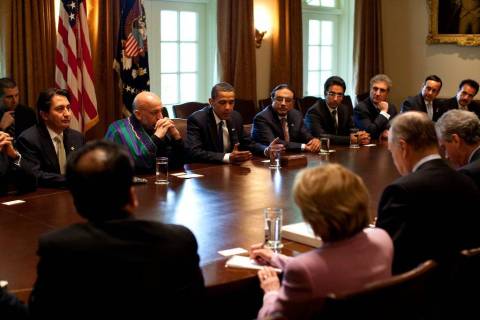
Please see this picture closely because, for the life of me, I can’t get over Bilawal Bhutto accompanying his father to a high-level meeting with Barack Obama and Hamid Karzai. (Can you ever imagine Obama bringing one of his daughters to a meeting like this or, for that matter, Bush one of his)? I know there are more important crises in Pakistan right now (the Refugees, the Economy, the Taliban), but I can’t let this go, even though I probably should.
I just have one question: WHY IS BILAWAL SITTING THERE? A 20 year old who does not even know how to tie his shoes – but then come to think of it neither does his father. Actually, I have one more question: what does it say about Zardari’s priorities that Bilawal is sitting closer to his father and Barack Obama than either Pakistan’s foreign minister (Shah Mahmood Qureshi, on Bilawal’s left) or Hussain Haqqani, Pakistan’s ambassador to the U.S. (to Qureshi’s left)?